Casio Edifice Automatic Series Review: Is Casio's First Automatic Watch Worth Buying?
 Berk OztoprakAuthor
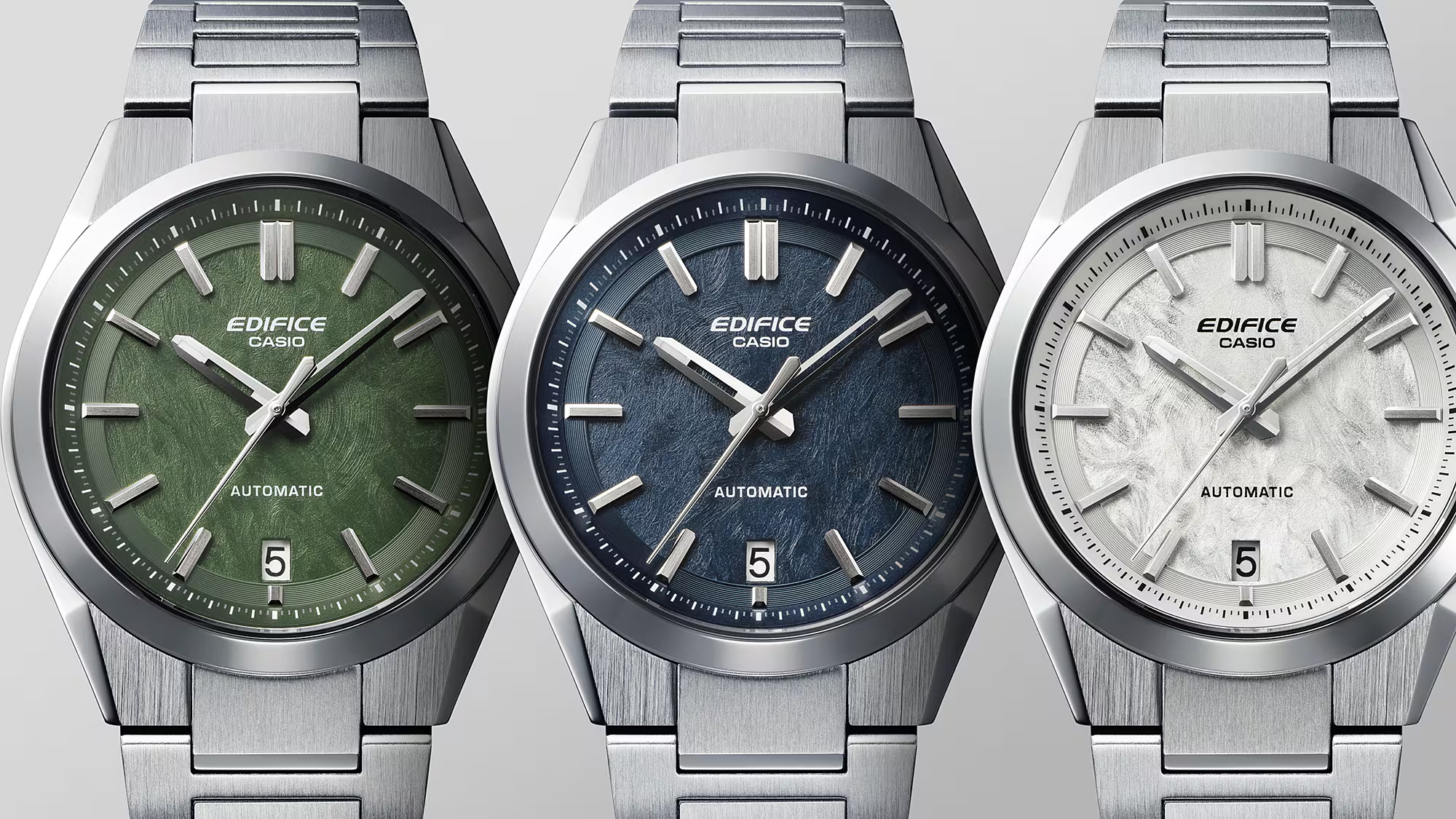
When most of us think of Casio, digital displays, G-SHOCK durability, and modern icons like the GA2100 immediately come to mind. Therefore, the Casio Edifice Automatic collection, at first glance, appears not just as a new model family, but as a groundbreaking shift in direction for the brand. In its official statements, Casio describes the EFK-100 series as both the first automatic movement for the EDIFICE line and, going even further, as the first mechanical movement in a Casio watch. At the heart of the collection are a 39mm steel case, sapphire crystal, 100-meter water resistance, a transparent case back, and approximately 40 hours of power reserve. But the real issue is bigger than the numbers: Casio is moving away from the comfort of quartz, which it has dominated for years, and for the first time, is seriously stepping into the emotional realm of mechanical watches.
Casio Edifice Automatic Collection
- The Casio Edifice Automatic is, according to the brand's official statement, Casio's first mechanical/automatic watch in its history.
- EFK-100D-2A, EFK-100D-3A, and EFK-100D-7A are not true forged carbon. The forged carbon appearance is achieved through electroforming.
- The EFK-100CD-1A uses a real forged carbon dial, which gives it a more special place in the series.
- The basic technical structure is robust: 43.5 × 39 × 12.5 mm case, sapphire crystal, 100 m water resistance, 24 jewels, 21.600 vph and approximately 40 hours power reserve.
- Its strongest point is the surprisingly balanced first try-on feel; its most controversial aspect is the lack of official name for the mechanical caliber and the potential for bracelet ergonomics to raise questions on smaller wrists.
Why did Casio make an automated Edifice now?
The transition from the quartz empire to the mechanical world is a bigger story than it seems.
Casio's reputation in the watch world has been built on a very clear foundation for years: accessibility, functionality, robustness, and, most often, reliability in quartz watches. From the F-91W to the G-Shock, and then to the more metallic and automotive-focused Edifice line, this path has positioned the brand on the side of sensible engineering, not mechanical romanticism. That's precisely why the Casio Edifice Automatic collection shouldn't be seen as just another product launch. Casio's official announcement on June 16, 2025, explicitly states that the EFK-100CD is the first model in the Edifice to use forged carbon and, more importantly, the first to feature a mechanical movement in a Casio watch. So, this isn't just a new reference, but a symbolic expansion in brand identity.
To understand why this move is coming now, we need to look at the gaps in the market. An assessment from a major media outlet like Monochrome suggests that in the affordable mechanical mod segment, the Swiss market is shifting towards higher price points. Citizen And he says that Seiko has gained strength, and Casio has entered precisely this gap. I think this comment is important. Because Casio isn't playing haute horlogerie here. On the contrary, it's opening a door that suits its own character. That is, it's establishing the first mechanical Casio not as an exaggerated niche display, but as an accessible yet noteworthy sports watch offering. This strategy also logically fits the brand's mass appeal.

The beauty of it is that Casio is doing this through the Edifice. And that's the right choice. Because the Edifice has already been positioned for years around motorsport, a metallic case language, and a more mature aesthetic. In its official collection pages, the brand also associates this series with the mechanical spirit of high-performance automobiles. The transparent case back emphasis, the engine metaphors, the forged carbon narrative… all of these tell us that Casio is entering the mechanical watch world not by denying its digital past, but by expanding the automotive-themed Edifice universe. And that, in my opinion, is the most convincing aspect of the collection. It doesn't look artificial. It doesn't seem outdated. Rather, it gives the feeling that the time has finally come.
Where does this watch stand among Casio, Edifice, G-Shock, and GA2100?
Not as robust as the G-Shock GA2100, but a more refined, calmer, and more mature Casio.
Many people's perception of Casio today is still based on G-Shock , and especially the GA2100 . This is very understandable. Because the GA-2100, in the official G-SHOCK narrative, with its octagonal bezel, Carbon Core Guard structure, 11.8 mm thickness, and 200-meter water resistance, is one of the strongest representatives of the new generation of rugged everyday Casio. Its dimensions of 48.5 × 45.4 × 11.8 mm, weight of 51 grams, and carbon/resin structure give it an almost "throw in your bag and go" character. In short, the GA2100's language is functionality, lightness, and impact resistance.
The Casio Edifice Automatic isn't exactly the opposite, but it definitely looks in a different direction. Here, it uses steel instead of resin. Instead of a digital-analog hybrid, it features a classic three-hand dial with a date window and a calm design. Measuring 43.5 × 39 × 12.5 mm and weighing 148 grams, the watch feels much more solid and traditional on the wrist. The sapphire crystal, clear screw-down case back, 100-meter water resistance, and automatic movement indicate that this watch is not a G-SHOCK alternative, but rather an answer from Casio for those seeking a more mature mechanical sports watch.

I think it's important to make this distinction clear. Because some users, upon seeing the Casio logo, will expect a price/hardness ratio similar to the GA2100. However, the Edifice automatic series sells character rather than shock resistance. Moreover, it does so without unnecessary ostentation. The case design is still sharp, still automotive-referenced. But the overall silhouette is calmer. As Fratello also emphasizes, the finish quality of the watch is surprisingly good for its price. The brushed surfaces, in particular, make a strong first impression. The same review also states that, due to the fixed first links, the watch's actual feel on the wrist can be perceived as longer than the official 43.5 mm lug-to-lug measurement, around 49 mm. This tells us that although this watch looks small on paper, it doesn't feel like a toy on the wrist.
In my view, Casio has made a very conscious distinction here. The GA2100 invites you outdoors, into action, sports, and the daily grind. The Edifice automatic, on the other hand, appeals to the shirt cuff, the office, dinner, and the feeling of wanting to feel my watch a little today. Think of it as two different narratives of masculinity from the same brand. One is practical and tough. The other is controlled and mechanical. Therefore, the success of the collection lies not in resembling G-Shock, but in daring to be different.
What is the difference between EFK-100CD-1A, EFK-100D-2A, EFK-100D-3A, and EFK-100D-7A?
There are two different stories within the same case: true forged carbon and forged carbon look.
This is the most crucial point of the collection. Because at first glance, the models may seem too similar. However, Casio clearly distinguishes between them on its official collection pages. The EFK-100CD-1A uses a real forged carbon dial; the EFK-100D-2A , EFK-100D-3A , and EFK-100D-7A have textured dials that mimic the forged carbon look using electroforming. This seemingly small difference significantly alters the emotional weight of the collection. The CD model is a watch with a material story. The D series, on the other hand, offers visual impact at a more accessible price.
Casio also explains forged carbon in a very informative way. According to the official text, this material is a lightweight and highly rigid composite formed by blending carbon fiber with resin and pressing it under high temperature and pressure. The best part is that the surface pattern naturally varies from piece to piece. So, the fact that the dial doesn't look the same on the EFK-100CD-1A isn't actually a flaw, it's a feature. If you're looking for a watch with a story about the materials, a small-scale production feel, and surface character, the CD model becomes a stronger recommendation for this reason.
On the other hand, the D series shouldn't be underestimated. Because the EFK-100D-2A in blue, the EFK-100D-3A in green, and the EFK-100D-7A in white appeal to a much wider range of tastes. Moreover, there are no major sacrifices on the technical side: 39 mm width, 12.5 mm thickness, 100 meters water resistance, sapphire crystal, automatic movement with manual winding support, seconds stop, 24 jewels, and 21.600 vph are all retained. According to Casio's European announcement, the recommended retail price for the D models is 279 euros, while the CD model with a forged carbon dial is priced at 299 euros. In the UK official store, the D-2A is priced at £269. Prices vary by market, but the general picture is this: the CD model offers a slightly more premium feel in terms of materials.

Therefore, I think the choice should be made as follows: If you want a more expressive piece in your collection when buying your first automatic Casio, the EFK-100CD-1A stands out. But if you want something more spacious, more colorful, and more suitable for everyday wear, the EFK-100D-2A and especially the EFK-100D-3A are very smart options. The EFK-100D-7A with its white dial appeals to those looking for summer use and a cleaner look. In short, there are no bad models here. Only differences in character.
Technical Summary
| Door Design | Dial structure | Color | Case dimensions | Cam | Waterproof | Mechanical properties |
| EFK-100CD-1A | Real forged carbon | Black | 43.5 × 39 × 12.5 mm | Sapphire | 100 m | Automatic + manual winding, 24 jewels, 21.600 vph, ~40 hours |
| EFK-100D-2A | Electroforming forged carbon appearance. | Blue | 43.5 × 39 × 12.5 mm | Sapphire | 100 m | Automatic + manual winding, 24 jewels, 21.600 vph, ~40 hours |
| EFK-100D-3A | Electroforming forged carbon appearance. | Green | 43.5 × 39 × 12.5 mm | Sapphire | 100 m | Automatic + manual winding, 24 jewels, 21.600 vph, ~40 hours |
| EFK-100D-7A | Electroforming forged carbon appearance. | White | 43.5 × 39 × 12.5 mm | Sapphire | 100 m | Automatic + manual winding, 24 jewels, 21.600 vph, ~40 hours |
This table is based on the common technical specifications and model-specific dial differences found on official Casio product pages.
For whom is it a logical choice, and for whom is it not?
For those buying their first automatic watch, it's powerful; for those seeking pure Casio nostalgia, it's a little foreign.
In my opinion, the strongest aspect of the Casio Edifice Automatic collection is its approach to the first-time automatic watch user without intimidating them. Technically, it looks serious enough, but the design isn't overly complex. Three hands, date display, sapphire crystal, 100-meter water resistance, transparent case back… all are very understandable for a beginner and not to be underestimated by a collector. On the mechanical side, Casio states a daily accuracy of -35/+45 seconds; this isn't a promise of lab-level accuracy, but rather an honest, workhorse-class approach to mechanical watches. It might not be romantic on paper, but it's realistic.
There's another important nuance here. Casio doesn't list the supplier name of the movement on its official product pages; they only share the technical specifications. However, independent publications like Fratello and Deployant identify the movement as Seiko/TMI NH35. Therefore, the safest interpretation is this: Casio seems to have opted for a familiar, unassuming, and well-known workhorse solution with a wide service ecosystem, familiar to collectors, in its first automatic entry. This will be seen as very clever by some, while others may feel it could have been bolder. Frankly, I find this decision logical for a first step. With this move, Casio wants to test its place in the automatic watch collection market. After seeing the positive and negative aspects of this test, they will listen to user feedback and perhaps one day accompany us watch enthusiasts with an in-house movement. Because the risk of failure is low with this type of movement. But yes, considering the brand's scale, it's hard not to want to see a more original Casio mechanical watch someday.

The area where the watch might not appeal to everyone starts with the wrist. Fratello points out the fixed first link, which is an important issue. Although the watch is 39mm, the actual wearing experience might feel longer. Users with thin wrists should try it on before making a decision. Also, don't expect luxuries like quick adjustment or tool-less micro-adjustment on the bracelet. The same review also states that Casio has prioritized the case and dial finish over these features. I don't find this choice bad, as the case and dial are the most visible parts of the watch. However, a note is necessary for users who prioritize comfort.
The short answer to the question "Who is it suitable for?" is: It's perfect for those who love Casio but are now looking for something a little more mechanical. Citizen Tsuyosa, Seiko 5 SportsFor those comparing it to entry-level automatics like the Orient Kamasu, it's a strong alternative. But if you're after the spirit of the F-91W, vintage digital nostalgia, or the raw, powerful character of the G-Shock, this watch might seem a little too polished. So it's more accurate to view this collection not as Casio's all-encompassing face, but as Casio's growing face.
Glossary of Terms
Let's simplify the concepts used while reading the text.
- Automatic mechanism: Mechanical system wound by arm movement. Manual winding is also supported in this series.
- Manual winding: Manually tension the spring via the cocking handle.
- Forged carbon: A lightweight, durable composite material formed by shaping carbon fiber and resin under high pressure.
- Electroforming: A surface production technique that mimics the feel of forged carbon on the dial. Used in the D series.
- Hacking function: The seconds hand stops when the crown is pulled. This allows for more precise adjustments.
- Power reserve: The amount of time the watch can continue to operate once it's fully wound. Approximately 40 hours in this series.
- 21.600 vph: The number of vibrations per hour of the mechanism. This value affects the behavior of the hour and minute hands and the flow of the second hand.
- Sapphire glass: This type of glass is much more resistant to scratches than mineral glass. Casio states that they use sapphire crystal in the series.
FAQ
Is the Casio Edifice Automatic really Casio's first automatic watch?
Yes. Casio's official statements describe this series as both the first mechanical movement within the Edifice and the first mechanical movement in a Casio timepiece. Therefore, the collection is not just a new model family, but a milestone in the brand's history.
Are the EFK-100D-2A, EFK-100D-3A, and EFK-100D-7A made of genuine forged carbon?
No. According to official collector's pages, these three models use electroformed textured dials that give the appearance of forged carbon, not forged carbon itself. For users who want a true forged carbon dial, the correct reference is the EFK-100CD-1A.
Why is the EFK-100CD-1A considered more special?
Because this model features a genuine forged carbon dial, and according to Casio, the surface pattern of this material naturally varies during the manufacturing process, resulting in slight differences in each piece. Therefore, the CD model isn't just a black alternative; it offers a stronger material narrative.
What exactly is the mechanism inside?
Casio doesn't name the movement on its official product pages. They only share specifications like 24 jewels, 21.600 vph, approximately 40 hours of power reserve, manual winding, and hacking. Independent sources like Fratello, Deployant, and aBlogtoWatch identify this movement as the Seiko/TMI NH35 or NH35A. The most cautious assessment is that it uses an unnamed workhorse automatic movement, but independent reviews associate it with the NH35 family.
Is this watch a good replacement for the G-Shock GA2100?
It's difficult to say it's a direct replacement. The GA2100 offers a completely different functionality with its carbon/resin construction, 200-meter water resistance, and shock resistance. The Edifice automatic, on the other hand, is a steel-cased, mechanical, heavier, and more refined everyday sports watch. One is task-oriented, the other is character-oriented. Therefore, the choice depends more on lifestyle than technology.
Is it worth buying considering the price?
The official European announcement gave a recommended price of €279 for the D series and €299 for the CD; the official UK page lists the EFK-100D-2A for £269. At this level, the sapphire crystal, 100-meter water resistance, mechanical construction, and robust surface finish make it quite competitive in my opinion. However, if you have small wrists and are sensitive to bracelet ergonomics, trying it on before buying might not be the best approach.
The Casio Edifice Automatic collection isn't perfect in my eyes, of course. But that's precisely why it's interesting. Because these watches don't look like weak, hastily released attempts just because they're making mechanical watches. On the contrary, they give the feeling that Casio has read its niche well and expanded in a controlled manner. The EFK-100CD-1A is more of a collector's item, the EFK-100D-2A and EFK-100D-3A are more for the general public, and the EFK-100D-7A offers a cleaner, summerier character. If you want to learn more about other Japanese watch brands like Casio , please read our next article.
This is not sponsored content. It is news content.
Keep reading
Related readings to this article