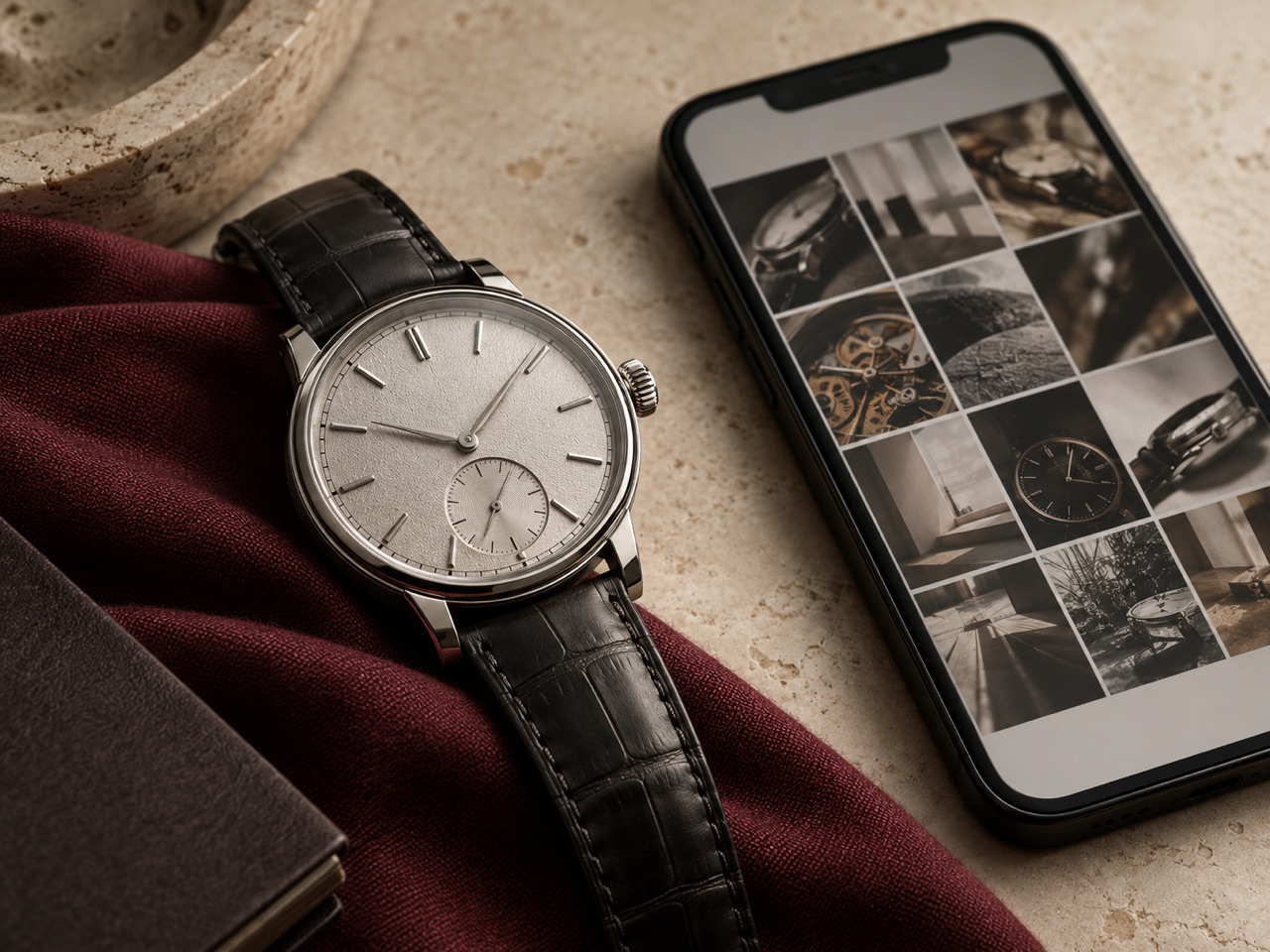
This glossary contains key terms and definitions from the world of horology and wristwatches. It provides a wide range of information on mechanical, wind-up, quartz, and electric watches.
General Horology Terms
Horology is the branch of science that studies time and time measurement. It deals with the design, manufacture, and repair of clocks, clock mechanisms, and other instruments that measure time.
Dial: The face of the watch. It is the part where the hour, minute hands, and other indicators are located, and where the time is read.
Case: The outer casing that protects the watch's movement and dial from external factors.
Strap/Bracelet: The part that allows the watch to be worn on the wrist. It can be made from various materials such as leather, metal, and rubber.
Crown: The button used to set and wind the watch.
Bezel: The ring, usually located at the top of the case, around the glass. In diver's watches, it may have additional functions such as timekeeping.
Arabic Numerals: Numbers like 1, 2, 3 used to show the time on a watch face.
Roman Numerals: The numbers used on a watch face, such as I, II, V, X.
Hands: The hands that indicate time, such as the hour hand, minute hand, and second hand.
Index: Symbols used in place of numbers on a dial.
Lug Width: The horn-shaped extensions where the case, strap, or bracelet is attached.
Crystal: The transparent cover that protects the dial. It is usually made of sapphire, mineral, or acrylic.
Mechanical Watch Terms
Mechanical watches are watches that store energy through the winding of a mainspring (mainspring) and operate by releasing this energy in a controlled manner through a series of gears and springs.
Power and Arming Mechanism
Mainspring: The spiral metal strip that stores energy by being wound, serving as the watch's power source.
Barrel: The cylindrical box containing the spring.
Winding Stem: The shaft attached to the top that is used to wind the spring.
Automatic Winding Movement: A movement in a watch that allows it to wind itself using a component called a rotor, activated by the wearer's wrist movements.
Rotor: In automatic watches, a semicircular weight that rotates with wrist movement to wind the mainspring.
Power Reserve: The time interval that indicates how long a fully wound mechanical watch can operate before needing to be rewound.
Power Reserve Indicator: A complication on the dial that displays the remaining operating time of the watch.
Gear System (Gear Train)
Gear Train (Wheel Train): A system of gears that transmits energy from the spring to the escapement mechanism.
• Center Wheel: It typically rotates a full turn once an hour and moves the minute hand.
• Third Wheel: It transmits the motion received from the central wheel to the fourth wheel.
• Fourth Wheel: It typically rotates one full turn per minute and moves the seconds hand.
Escapement
Escapement: The critical mechanism that transfers energy from the gear train to the oscillation element (balance wheel) at regular intervals and in a controlled manner, producing the "ticking" sound of the clock.
• Lever Escapement: The most common type of escapement used in modern mechanical watches. It is reliable and precise.
• Escape Wheel: A wheel with specially shaped teeth, which is part of the escape mechanism.
• Anchor (Pallet Fork): An anchor-shaped part that attaches to the teeth of the escapement wheel and controls its movement.
Oscillating System
Balance Wheel: The wheel that oscillates back and forth, determining the timekeeping accuracy of the watch. It is considered the "heart" of the watch.
Balance Spring (Hairspring): A very thin spiral spring that allows the balance wheel to oscillate in a regular rhythm.
Regulator: A small lever used to adjust the watch speed by changing the effective length of the balance spring.
Shock Protection System: A system that prevents damage to the delicate balance wheel pivots of the watch in the event of a fall or impact (e.g., Incabloc).
Complications
Complication is the general name given to additional functions of a watch other than showing time (hours, minutes, seconds).
Chronograph: A complication used to measure time intervals, i.e., it functions as a stopwatch. It has additional buttons for starting, stopping, and resetting.
• Flyback Chronograph: A type of chronograph that instantly resets and restarts when the reset button is pressed while it is running, without the need to stop the chronograph.
• Rattrapante (Split-Seconds Chronograph): A complex chronograph with two overlapping second hands that can measure two different time periods simultaneously.
Calendar:
• Date: Shows the day of the month.
• Day-Date: Shows the day of the week and the date of the month.
• Annual Calendar: Displays the date, day, and month; requires manual adjustment only at the end of February (in non-leap years).
• Perpetual Calendar: A highly complex calendar mechanism that takes leap years into account and requires no manual adjustment for 100 years (until 2100).
Moon Phase: A complication that displays the phases of the moon (new moon, full moon, crescent, etc.) in a window on the dial.
GMT (Greenwich Mean Time) / Dual Time Zone: A complication that displays two different time zones simultaneously. Usually indicated with an additional 24-hour hour hand.
Tourbillon: A complex and prestigious mechanism that places the escapement and balance wheel inside a cage that continuously rotates around its own axis to reduce the negative effects of gravity on the watch's accuracy.
Minute Repeater: A highly sophisticated complication that, when a button is pressed, announces the hour, quarter hour, and minute with different tones (like bell sounds).
Alarm: A complication that provides an audible warning at a preset time.
Quartz (Battery) and Electric Clock Terms
Quartz watches are powered by a battery and use the electronic vibrations of a quartz crystal to measure time. They are much more accurate and require less maintenance than mechanical watches.
Quartz crystal: A synthetic crystal that vibrates at a very precise and constant frequency (typically 32,768 Hz) when an electric current is applied, forming the basis of time measurement.
Piezoelectric Effect: The property of a quartz crystal to vibrate when electricity is applied and to generate an electrical signal when mechanical pressure is applied.
Battery: The energy source that powers the watch's electronic circuitry and motor.
Integrated Circuit (IC): The electronic brain that counts the vibrations of a quartz crystal, divides these vibrations into seconds, minutes, and hours signals, and sends commands to the stepper motor.
Stepper Motor: A small motor that converts electrical signals from an integrated circuit into mechanical motion that moves the hour and minute hands of a clock.
LCD (Liquid Crystal Display): A liquid crystal display used to show time and other information in digital clocks.
Electric Watch: These watches, which emerged before the quartz revolution, are powered by a battery but use a mechanical balance wheel or tuning fork to measure time. They represent a transitional technology between mechanical and quartz watches.
Tuning Fork Watch: A type of electric clock that uses the frequency of an electrically vibrating tuning fork to measure time instead of a balance wheel. The best-known example is the Bulova Accutron, which produces a continuous buzzing sound.
Solar: Quartz watch technology that converts light energy into electrical energy via a panel under the dial and stores it in a rechargeable battery.
Kinetic: A quartz watch technology that converts the wearer's kinetic energy into electrical energy, charging a rechargeable battery, using a mechanism similar to the rotor in automatic mechanical watches.
Other Important Terms
Water Resistance: This refers to a watch's resistance to water up to a certain pressure (usually specified in meters or atmospheres – ATM). The term "waterproof" is no longer used because it is misleading.
Chronometer: A designation given to watches that possess a certificate from the Swiss Official Chronometer Testing Institute (COSC), certifying that they meet high precision standards. This term should not be confused with chronograph (timekeeping device).
Geneva Seal (Poinçon de Genève): A prestigious certificate awarded only to watches produced in the canton of Geneva, signifying that they meet very high standards of craftsmanship, quality, and decoration.
Finishing/Decoration: Fine craftsmanship applied to the parts of a clock mechanism for aesthetic purposes. Examples include Geneva lines (Côtes de Genève), perlage (circular graining), and anglage (chamfering).