Interview with Arnaud De Bal, Founder of L'Artisan: The Young Face of Independent Watchmaking
 Berk OztoprakAuthor

When independent watchmaking is mentioned, one often imagines a small workshop in Switzerland, decades of training, and a watchmaker with a long history in the industry. Arnaud De Bal's story, however, begins from a very different point.
You can find the technical basis of enamel work, which is part of L'Artisan's future plans, along with the production stages, in our enamel dial guide.
You can read in detail about how the enamel work, which is part of L'Artisan's future plans, is applied in an independent workshop in the O&HoraPictor enamel watchmaking interview .
De Bal, the man behind Belgium-based L'Artisan, didn't learn watchmaking at a traditional watchmaking school. His fascination with watches, which began at a young age, eventually evolved into a desire to make his own. Then came a process of trial and error, largely learned through self-study.

Today, L'Artisan is particularly striving to carve out a niche for itself around natural stones and unusual dial materials. The brand's Jurassic model is one of the most extreme examples: its dial uses a fossilized dinosaur bone approximately 66-68 million years old. However, De Bal's goal is not limited to producing dials from interesting materials. The brand's official narrative describes 2026 as a transition to a more ambitious era with more complex case architectures, new mechanisms, enamel, mother-of-pearl mosaic, and precious metals.
We spoke with Arnaud De Bal about how L'Artisan began, the advantages and disadvantages of learning to make watches yourself, his search for materials ranging from gemstone dials to fossilized dinosaur bone, the increasingly blurred line between microbranding and independent watchmaking, and what kind of brand he envisions L'Artisan becoming in the future.
Who is Arnaud De Bal?
Bersenti: Before we talk about watches, craftsmanship, and L'Artisan, could you introduce yourself to our readers? Who is Arnaud De Bal, and how would you describe the journey that brought you to where you are today?
Arnaud De Bal: My name is Arnaud De Bal, and I am the founder of L'Artisan, an independent watch brand based in Belgium. The story actually begins in high school. When I was about fourteen, my family gave me my first watch as a gift, and from that moment on, I was completely hooked. I spent an incredible amount of time online; consuming everything I could find about watches, including brands, movements, history, and auction results. At the time, I didn't have the budget to buy anything, but I enjoyed looking at and learning about watches. That period forms the basis of everything I do today.
No one in my family shares this kind of addictive passion, so I learned almost everything I know on my own. I studied applied economics and started a master's program, but at some point it became clear that the workshop was where I really wanted to spend my days. I dropped out of the program and focused entirely on the brand. I'm still involved today: casting, machining, laser engraving, enameling, dials, assembly, and finishing.
From loving watches to making watches
Bersenti: You became interested in watches when you were just 16 years old, and just a year later, without any formal training or industry connections, you decided to try making your own watch. What was it that took you from simply liking watches to actually wanting to produce them?
Arnaud De Bal: I was about to graduate from high school, and my family was kind enough to buy me a watch within a certain budget. I spent a lot of time thinking about what to choose and looking at the options. Vintage watches have always fascinated me: their designs, their stories, and above all, their dials. Especially the gemstone dials.

The problem was simple. These dials on vintage watches were completely out of my reach, and at the time there were virtually no real alternatives on the market. They're much more common today, but back then, such an option wasn't available at my level. This led me to consider: couldn't I make a watch with a gemstone dial for myself? I never planned on starting a brand. I just wanted a single watch for personal use because I loved gemstone dials so much.
Learning to make your own clock
Bersenti: You're essentially a self-taught watchmaker. Looking back today, was there a particular mistake or failure you made in your early years that probably taught you more than any formal training?
Arnaud De Bal: Self-study is both a curse and a blessing at the same time. A curse, because you absolutely have to figure everything out on your own and you progress very slowly at first. My years between seventeen and twenty were a long learning curve. I was taking watches apart and initially couldn't even put them back together. I broke a lot of dials, and really a lot of gem dials.
But the curse itself is also a blessing. In most watchmaking schools, there's only one right way to do something; in reality, a problem can be solved in many different ways. Self-learning forces you to think critically and experience failure firsthand. You feel it when you mess up a project in school, but you also feel the financial blow when you mess up a watch for your own brand. That lesson sticks.

But the real driving force is curiosity. An almost obsessive level of interest is what allows you to move quickly on this self-taught path. Because of how obsessed I am with watches and the processes behind watchmaking, I'm often asked if I'm on the spectrum. I've never been officially diagnosed, but it's probably partly to some extent.
The unseen difficulty of a clock.
Bersenti: Today, assembly, polishing, and finishing still take place in his own workshop in Belgium. What is one aspect of watchmaking that seems relatively simple to the customer but is actually incredibly difficult to execute well?
Arnaud De Bal: For me, the most challenging part is the entire R&D process behind a new piece. There are many brands across the industry with very good designers, but production is entirely outsourced. As a result, they design things that are actually extremely difficult to produce. By increasingly bringing more processes in-house, we are integrating aesthetic design directly into the production process itself, and very few brands at our level are doing this.
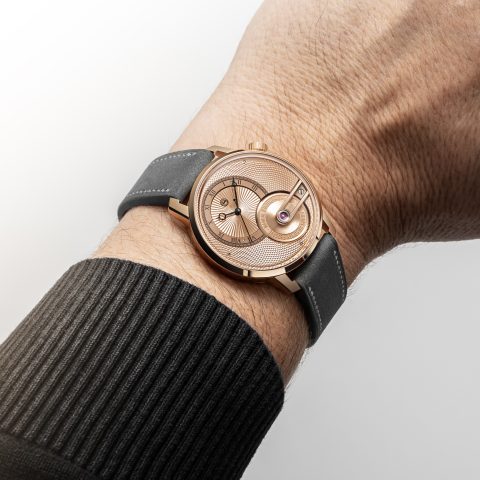
Let me give you a concrete example: The rose gold prototype I'm wearing. Because the case couldn't be machined exactly as I wanted, it had to be cast. It was cast five times until the measurements were correct because gold shrinks as it cools, and the case still needs to remain waterproof. Then, any imperfections are laser-welded, sanded, and mirror-polished. From the customer's perspective, it's simply a polished gold case.
It's difficult to accumulate this knowledge because instead of specializing in one area, you need to understand a bit of every stage of production. However, I believe that all of this will accumulate over time and will be useful in the projects I have in mind in the future.
From stone dials to fossils
Bersenti: Stone dials have become one of L'Artisan's signatures, and you spent about six months researching and experimenting before achieving the desired result. What is it about natural and unusual materials that fascinates you so much, and what makes you look at a material and say, "This could be transformed into a dial"?
Arnaud De Bal: The very first watch I made had a lapis lazuli dial. Back then, that was still quite unique, and you didn't come across those dials very often. Nowadays, gemstone dials are everywhere, and frankly, that started to bore me, so I started looking elsewhere. The gemstone world is incredibly vast, and a huge part of it is still completely unexplored in watchmaking.
The moment I started looking at the fossilized material, an idea struck me. To be honest, I didn't think it would work. Still, I tried. The first cut in Jurassic wasn't very successful: we managed to extract eight quadrants from a kilogram of stone, meaning more than 99 percent of the material was waste. But I loved the idea, the story, and the look so much that I wanted to continue down that path.
I think it's fair to say that L'Artisan has become one of the more interesting gemstone dial brands on the market today. We have a large number of highly exclusive materials, many of which have not yet been released to the market or are reserved for our piece unique program.
When did dinosaur bones become a craft?
Bersenti: You've gone so far as to work with real fossilized dinosaur bones in models like Jurassic. In your opinion, at what point does the use of an unusual material become true craftsmanship and watchmaking, and at what point does it risk being just a marketing ploy?
Arnaud De Bal: There's a very fine line. That's precisely why we make very limited drops from each material; to keep them special. But there's a practical answer to that: even if I wanted to, it wouldn't be possible to produce a hundred Jurassic models. You simply couldn't find materials of sufficient quality to make that many watches. I think that answers the question perfectly. The limit is determined by the material itself, not by marketing.

That's why I've also decided to end Jurassic. It will be discontinued, and I'll move on to other interesting materials that deserve attention. I still have a long list of things I want to work with. My vision for the future is to combine these stones with other types of craftsmanship: guilloché, hand engraving, enamel. This is where an unusual material ceases to be a novelty and becomes real watchmaking.
Microbranding or independent watchmaking?
Bersenti: L'Artisan defines itself as independent Belgian watchmaking. But today, the line between a microbrand, an independent brand, and an independent watchmaker is increasingly blurred. Where do you see L'Artisan in this picture, and what does "independent watchmaking" personally mean to you?
Arnaud De Bal: It's true that the line is becoming increasingly blurred. For me, an independent brand is one that is run by a very small group of people, produces a small number of watches, and makes its own decisions.
L'Artisan is a somewhat special case because I'm really using the brand and its success to build a body of knowledge that I can then apply. Right now we're working on projects that will directly enter the independent watchmaking space; many pieces will be produced in-house and components will be hand-finished. I can't say too much yet, but it will be impressive when it comes out.
I started steering the brand in this direction because my interest is increasingly shifting towards the production processes themselves. This is also why I haven't launched many new watches lately. The projects we have in mind will represent a significant leap forward.
Will L'Artisan create its own mechanism?
Bersenti: With the Jurassic, you also switched to a micro-rotor mechanism; this suggests that L'Artisan is gradually becoming more ambitious beyond just the dial. What is the most important thing for you when choosing a mechanism? And do you have a long-term dream of developing a seriously modified, or even entirely L'Artisan-owned, caliber?
Arnaud De Bal: Initially, the mechanism wasn't that important to me. What mattered to me was the dial. Now that I've reached a point where I'm satisfied with our dials, I've started to seriously look at the mechanism side of things.
As I mentioned, we are currently working on several projects using Swiss mechanisms where some parts are being replaced with components that are manufactured and finished in-house. That's a realistic next step, and it teaches you an incredible amount. The ultimate dream, of course, is to produce a caliber entirely in-house, and I'm quite confident that this will be something that happens for the brand in the future.
More hours, or better hours?
Bersenti: L'Artisan watches are used in more than 40 countries today, but every watch still passes through your hands. If demand suddenly increased fivefold, would you choose to build a team and increase production, or would you consciously keep L'Artisan as a small, limited atelier?
Arnaud De Bal: I would rather produce fewer parts of higher quality than produce more and allow quality to decline. It's not a difficult choice for me.
Actually, I've started building a team. Currently, two watchmakers are working with me part-time. But the important point is: they're not here because demand suddenly increased. They're working with me on the brand's vision and the new prototypes we're developing. So the direction is clear: to move towards the higher segment and produce fewer watches overall.
How can you recognize L'Artisan without a logo?
Bersenti: Imagine we completely removed the logo from a L'Artisan watch. In the future, what design or craftsmanship codes would you want collectors to immediately recognize and say, "This is definitely a L'Artisan"?
Arnaud De Bal: I draw a lot of inspiration from H. Moser & Cie. They don't put a huge logo on the dial that you can see from across the room, but you can still instantly recognize a Moser by its dial. That's exactly what I wanted for L'Artisan.
The material itself, the way it's cut and finished, and the subsequent handiwork around it should be sufficient. If you still know who the watch belonged to when the name disappears, then we've done our job.
Is independent watchmaking truly experiencing its golden age?
Bersenti: Independent watchmaking is probably more visible than ever, but at the same time we're seeing new microbrands emerging almost every week. Do you think we're truly in the golden age of independent watchmaking, or are we reaching a point where good marketing is sometimes more important than good watchmaking?
Arnaud De Bal: I don't think we're in the golden age of independent watchmaking. I see it more as a consequence of what happened during the Covid period. People were treated badly by big brands and couldn't get the watches they wanted; at the same time, they became much more educated about watches.
It's a fact that in the independent world, the value you get for your money is often significantly higher. In my opinion, that's the main reason independent brands thrive. The second reason is proximity. With a small brand, you can talk to the person who made the watch and often order something personalized; that's not possible with large maisons.
Therefore, I believe the current trend will continue in the long term.
Ten years later, L'Artisan
Bersenti: Finally, let's completely remove the age from the story. Let's forget labels like "young watchmaker" or "young founder." Ten years from now, when a collector hears the name L'Artisan, what's the one thing you want them to associate with the brand?
Arnaud De Bal: Original and bold ideas. Trying things nobody else has thought of. Not on the mechanical side because we'll never beat the big brands there; but we can do that in the use of materials.
This is where we can make a real difference: using materials never before used in watchmaking, trying many different things until one thing works.
I also want to keep the company young; a company that still allows us to make mistakes. The more mistakes, the better, because that's where real innovation comes from. Those who never try never discover anything new.
I hope this will still be true ten years from now.
Keep reading
Related readings to this article